

Monday, 29 June 2026

Monday, 18 March 2019


Sunday, 8 July 2018
পৃথিবী
ঘুরছে সূযে'র চারদিকে মঙ্গল ও তাই । দুজনের কক্ষপথ আলাদা। দুটোই প্রায়
উপবৃত্তাকার। এদের নিজেদের দুরত্ব সব সময় সমান থাকে না কখনো কম কখনো
বেশী।এখন দুরত্ব সবথেকে কম। একে মঙ্গলের প্রতিযোগ (opposition) বলে। এই
সময় পৃথিবী থেকে অনেকটা বড় দেখায়।এখন যেমন সন্ধের একটু পরেই পূব আকাশে একটা
লাল জ্বলজলে গ্রহ দেখতে পাবেন ওটাই মঙ্গল।শেষ মঙ্গল এত কাছে এসেছিল 2003
সালে। সমস্ত মানুষ আগ্রহে আনন্দে দেখেছিল এই সুন্দর
গ্রহকে ,দেখেছিল মঙ্গলের দুই মেরুর বরফের টুপি (শুধু জলের নয়)।প্রসঙ্গত
সৌরজগতে মঙ্গল ই একমাত্র গ্রহ যার পৃষ্ঠতল পৃথিবী থেকে দূরবীণের
(telescope) সাহায্যে দেখা যায়। আগামী 27 শে জুলাই মঙ্গল পৃথিবীর সবচেয়ে
কাছে আসবে। ওই দিন আবার দীঘ'তম চন্দ্রগ্রহণ হবে। তবে আসুন তার তার আগে
থেকেই দেখি মঙ্গলকে ওই দিনের সঙ্গে আজকের আকারের আহামরি কিছু ফারাক হবে না।
দেরি করার কিছু বিপদ ও আছে ,মঙ্গলে মাঝে মধ্যেই ধুলোর ঝড় হয় যা ঢেকে দেয়
মঙ্গলের মাটিকে।তাই আগেভাগেই দেখে নিন আষাঢ়ের মেঘকে পরাস্ত করে।আপনার
অঞ্চলে কার দূরবীণ আছে খুঁজে নিয়ে অন্যদের দেখানোর ব্যবস্থা করুন।
Saturday, 8 February 2014

Saturday, 14 September 2013
Celebrating 25 Years of Sky Watching Guide
Sky Watchers’ Association, Kolkata has organized a seminar , ”Celebrating 25 Years of Sky Watching Guide” on 20 th September 2013 ,Friday , at 5 pm at Jibanananda Sabhagar (beside NANDAN) to commemorate the completion of 25 years of its monthly magazine, Sky Watching Guide .
This will also follow by a lecture on " WHY ASTROLOGY IS NOT A SCIENCE", by Mr. Soumen Mukherjee, a veteran amateur astronomer, and senior member of SWA-Kolkata.
All are cordially invited to attend and grace the occasion.
(This is an 'open-to-all' program)


This will also follow by a lecture on " WHY ASTROLOGY IS NOT A SCIENCE", by Mr. Soumen Mukherjee, a veteran amateur astronomer, and senior member of SWA-Kolkata.
All are cordially invited to attend and grace the occasion.
(This is an 'open-to-all' program)


Tuesday, 16 April 2013


Tuesday, 22 January 2013
BETELGUESE

22 January
2013
Multiple
arcs are revealed around Betelgeuse, the nearest red supergiant star to Earth,
in this new image from ESA’s Herschel space observatory. The star and its
arc-shaped shields could collide with an intriguing dusty ‘wall’ in 5000 years.
Betelgeuse
rides on the shoulder of the constellation Orion the Hunter. It can easily be
seen with the naked eye in the northern hemisphere winter night sky as the
orange–red star above and to the left of Orion’s famous three-star belt.
Roughly 1000
times the diameter of our Sun and shining 100 000 times more brightly,
Betelgeuse’s impressive statistics come with a cost. For this star is likely on
its way to a spectacular supernova explosion, having already swelled into a red
supergiant and shed a significant fraction of its outer layers.
The new
far-infrared view from Herschel shows how the star’s winds are crashing against
the surrounding interstellar medium, creating a bow shock as the star moves
through space at speeds of around 30 km/s.
A series of
broken, dusty arcs ahead of the star’s direction of motion testify to a
turbulent history of mass loss.
Closer to
the star itself, an inner envelope of material shows a pronounced asymmetric
structure. Large convective cells in the star’s outer atmosphere have likely resulted
in localised, clumpy ejections of dusty debris at different stages in the past.
An
intriguing linear structure is also seen further away from the star, beyond the
dusty arcs. While some earlier theories proposed that this bar was a result of
material ejected during a previous stage of stellar evolution, analysis of the
new image suggests that it is either a linear filament linked to the Galaxy’s
magnetic field, or the edge of a nearby interstellar cloud that is being
illuminated by Betelgeuse.
If the bar
is a completely separate object, then taking into account the motion of
Betelgeuse and its arcs and the separation between them and the bar, the
outermost arc will collide with the bar in just 5000 years, with the red
supergiant star itself hitting the bar roughly 12 500 years later.
“The
enigmatic nature of the circumstellar envelope and bow shock surrounding
Betelgeuse as revealed by Herschel,” by L. Decin et al, was published in Astronomy
& Astrophysics, December 2012.
Saturday, 10 November 2012
A Special Talk
%20cropped.jpg) |
| Dr. Dipankar Maitra |
A
special “very informal” talk by
Dr.
Dipankar Maitra, University of Michigan,
Ann Arbor,Michigan.
Subject:
Measuring
how fast black holes spin.
Date,
time and place:
24
November 2012, 6:00 pm at Sky Watchers’ Association, Dhakuria
Tuesday, 23 October 2012


Sunday, 2 September 2012


Friday, 31 August 2012
Thursday, 23 August 2012

Saturday, 23 June 2012

Wednesday, 20 June 2012
Asteroid 2012 DA14 will be seen on February 15, 2013
About
2012 DA14 is a near earth asteroid with an estimated diameter of about 44 meters and an estimated mass of about 120,000 metric tons.[1] It was discovered on February 23, 2012, by the OAM Observatory, La Sagra in Spain (J75). Calculations show that on February 15, 2013, the distance between the asteroid and the Earth will be 0.09 LD (35,000 km; 21,000 mi).

Risks
- As of May 1, 2012, the odds of impact on 2020-Feb-16 are 1 in 37,037,000.[1]
- There is an estimated cumulative 0.031% risk (1 in 3,230) of 2012 DA14 impacting Earth sometime between 2020 and 2082.[1]
- It is rated a low −3.19 on the Palermo Scale.[5] (The risk is less than one thousandth of the estimated risk of another similarly sized near earth asteroid hitting the Earth during that time period.[6] It is estimated that there are more than a million near-Earth asteroids smaller than 100 meters.)[7]
- It rates 0 (No Hazard) on the Torino scale.[1]
If it were to strike the Earth, it is estimated that it would produce the equivalent of 2.4 megatons of TNT.[1] The Tunguska event has been estimated at 3−20 megatons.[8]
On February 15, 2013, DA14 will pass no closer than 0.000181 AU (27,100 km; 16,800 mi) from the center-point of the Earth,[9] which is no closer to the Earth's surface than 3.2 Earth radii.[4] Thenominal pass will be 0.00023 AU (34,000 km; 21,000 mi) from the center-point of the Earth.[9] This is potentially closer than satellites in geosynchronous orbit. The asteroid will not be visible to the naked eye.[4] Due to the uncertainty in the observation arc of 79 days, there is a small possibility that the asteroid will pass 0.00035 AU (52,000 km; 33,000 mi) from the Earth on February 15, 2013.
Thursday, 7 June 2012
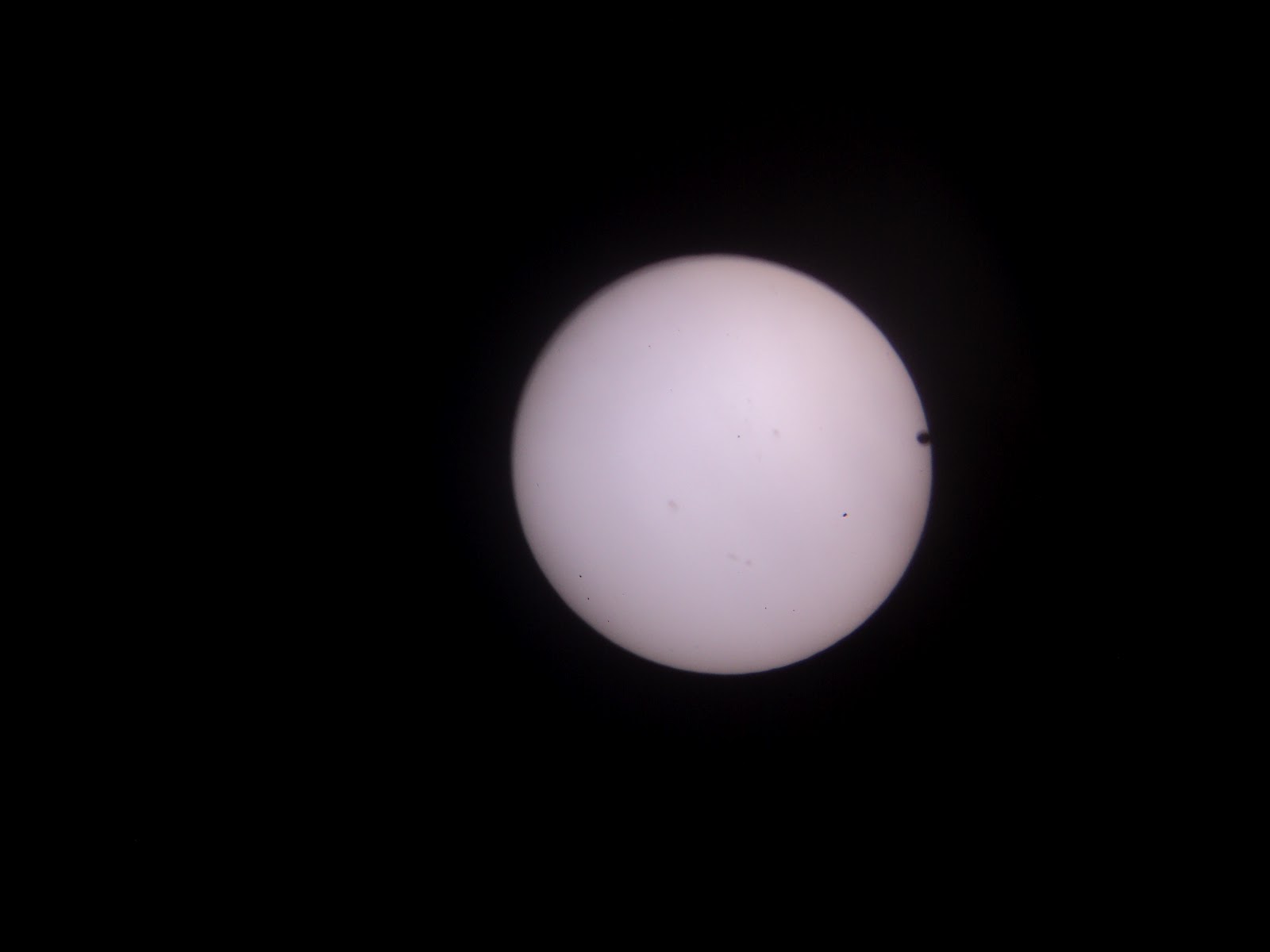
Transit of Venus
Transit of Venus
All the photos were taken at:
Jagadis Bose National Science Talent Search
1300 Rajdanga Main Road, Kashba,
Kolkata-700107


Samindra Basu
Wednesday, 6 June 2012




Subscribe to:
Posts (Atom)